Catalog topic · Format & Platform
Desktop Module audio gear
Browse 11 public product pages associated with Desktop Module on Eura.
Related format & platform topics
Products related to Desktop Module
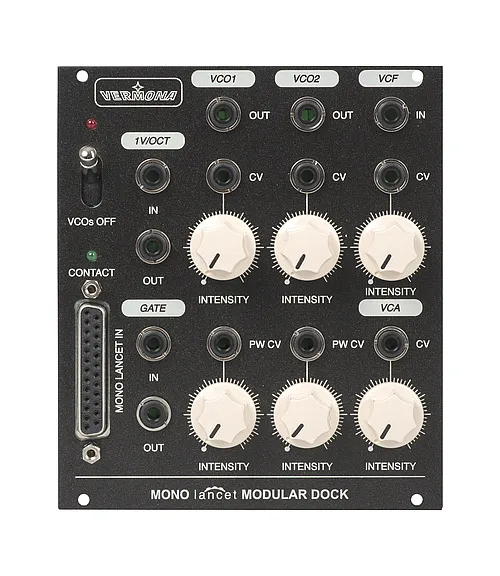
Vermona Modular Dock
The Modular Dock is a Eurorack extension for Vermona’s Mono Lancet and Mono Lancet ’15, designed to route the VCOs, VCF, and VCA from those synths to the outside world and expand their functionality within a modular system. It enables cross-modulation, pulsewidth and amplitude modulation, and offers additional modulation and external integration options to broaden the sound palette. With Modular Dock, you can extend the Mono Lancet’s sound engine by adding external VCAs, the fourMulator, VCDrive, or modules from other manufacturers, creating new sonic possibilities. The module acts as a bridge between Vermona’s compact core and a Eurorack setup, making it a potential starting point for modular exploration or a substantial upgrade to an existing system. Typical use scenarios include pairing the Dock with Mono Lancet ’15 to learn its new modulation capabilities, or using it to sculpt external sources through the Mono Lancet’s filter and envelopes. It supports inputs for FM and PWM on both VCOs, a VCF input, CV and VCA control, and 1V/octave CV and gate for the VCOs, along with dedicated outputs for VCOs and a 1V/Octave CV.
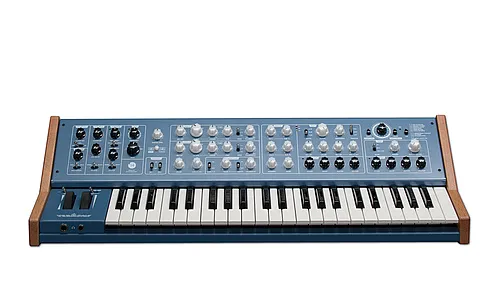
Vermona ’14 Analogsynthesizer
The ’14 Analogsynthesizer is a monophonic analog synthesizer from Vermona, categorized under elektroakustische manufaktur, synthesizer. It is handmade in Germany and is limited to 222 units. Its voice architecture centers on two analog oscillators, a lowpass filter, and a VCA, with two envelope generators, an LFO, and a vibrato generator. The instrument offers extensive sound shaping via a dedicated control surface with keyboard, pitch and modulation wheels, and individual controls for main outputs and headphone output. Key features include VCOs with multiple octaves and tunings, pulse-width modulation, a sub-oscillator, various modulation destinations (including VCF modulation), and an arpeggiator with multiple modes and up to 60 notes. The build emphasizes warm, musical analog character and hands-on control for dynamic lead and bass sounds. Connectivity supports flexible integration: unbalanced 1/4" line outputs, transformer-balanced XLR outputs, 1/8" and 1/4" audio inputs, and CV/Gate and MIDI I/O (IN, OUT, THRU). A sustain pedal input and a volume pedal with a trim-pot for minimum volume are included, enabling expressive performance setups. The unit weighs 6.5 kg and measures 770 x 310 x 150 mm.
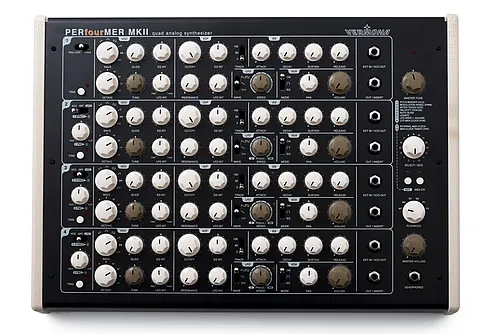
Vermona PERfourMER MKII
The Vermona PERfourMER MKII is a quad analog synthesizer in a rack format. It comprises four independent monophonic synth channels that can be linked or played together in various configurations, effectively yielding four voices or an ensemble of individual instruments. Each channel is built around a classic VCO/VCF/VCA signal path, starting from an analog oscillator with multiple waveforms and a noise source, through a 24 dB/Oct low-pass filter with adjustable resonance, and into a discrete VCA. Modulation options include a flexible LFO and an ADSR envelope generator for VCO, VCF, and VCA, with support for hard-sync and FM interactions between channels. The design supports diverse play modes (monophonic, duophonic, polyphonic) and synchronization between channels, enabling complex textures and layered sounds. Typical use cases include live performance and studio sound design, where a single PERfourMER MKII can function as four separate instruments or as a cohesive four-voice synth. The device offers MIDI control and optional CV/Gate inputs, with individual channel controls for each function, facilitating real-time manipulation and hands-on exploration of subtractive synthesis and evolving textures.
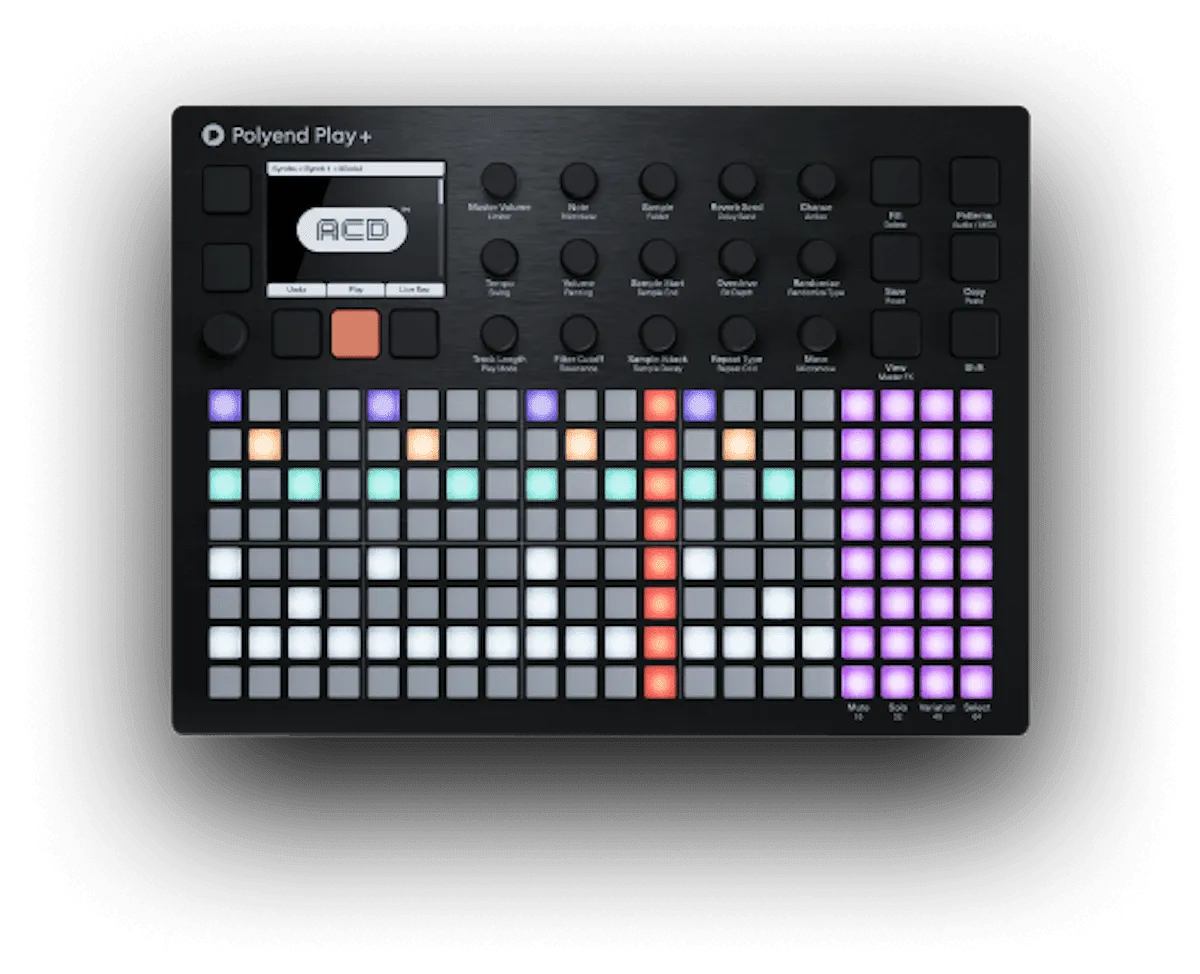
Polyend Play+
Polyend Play+ is a Groove Machine that functions as a 16-track groovebox with multisourced synthesis and stereo sampling capabilities. It features an upgraded internal architecture designed to deliver richer stereo sounds and multitimbral polyphonic synthesis, while enabling seamless audio over USB to a DAW. The device also includes a new patch editor and a dedicated stereo expansion for samples, alongside multi-track USB audio collaboration. Notable elements include several built-in synth engines, a patch editing workflow with 9 encoders for patch parameters, and dedicated per-track performance features. The Play+ can send up to 14 stereo tracks to a DAW over USB, supporting multi-track audio workflows, and provides a range of effects such as delay, reverb, bitcrusher, overdrive, and master EQ to shape sounds. Typical use cases center on live playing and studio pattern creation, leveraging the Perform mode and various generative options to craft rhythms and evolving textures. The unit is described as suitable for creating and modeling rhythms and patterns with multiple tracks, while offering a flexible workflow for immediate playability and on-the-fly sound design.
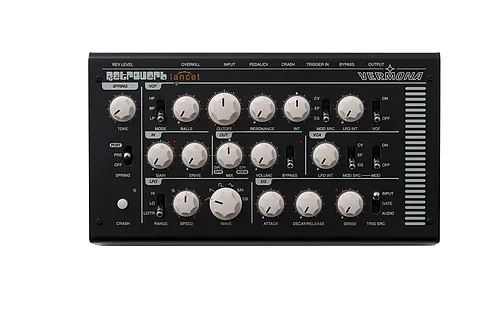
Vermona Retroverb Lancet
The Vermona Retroverb Lancet is an analogue multi-effect processor designed for effect enthusiasts. It combines spring reverberation, analogue multimode filtering, a VCA, and overdrive, all modulated by an ultra-fast LFO and a flexible envelope. The module is tailored to accept signals from guitars, basses, keyboards, organs, or microphones, and can generate percussion sounds using a dedicated crash function. Key features include a three-spring reverb with a selectable pre- or post-routing path, a versatile filter with 24 dB/octave slopes (low-pass, high-pass) and 12 dB/octave (band-pass), and a control set that includes an envelope generator, envelope follower, and external CV for modulation. The device uses an external 12 V/1000 mA power supply and remains fully analogue, offering a broad palette of textures from subtle modulation to more aggressive tones. Common use scenarios encompass shaping guitars, synths, or vocal material with space and character via spring reverb, dynamic filter sweeps, and harmonic overdrive. The unit’s crash and envelope-driven modulation enable percussive, tempo-synced, or evolving effects, making it a flexible sound-design tool for studio and performance contexts.

Arturia MicroFreak
The Arturia MicroFreak is presented as a hybrid hardware synthesizer, blending digital and analog-inspired elements in a compact instrument. It features a versatile digital oscillator with multiple modes, paired with an analog state-variable filter that can self-oscillate. Its unique 25-note PCB “keyboard” supports poly-aftertouch, and the instrument includes a polyphonic arpeggiator/sequencer, a 5x7 modulation matrix, and 512 preset slots (320 factory presets). A small OLED screen helps navigate settings and sounds. Key capabilities enable flexible sound design and live experimentation. The device offers an assignable modulation matrix with five sources and seven destinations, plus three user-defined points, and supports Spice and Dice randomization to shape sequences. It can be connected via USB, MIDI (via 3.5 mm breakout cables), and CV/Gate outputs to integrate with other gear, modular systems, or DAW control. Power is supplied by a PSU with USB power compatibility, and the unit includes a standard 3.5 mm headphone output and a 1/4" line-level output for monitoring.
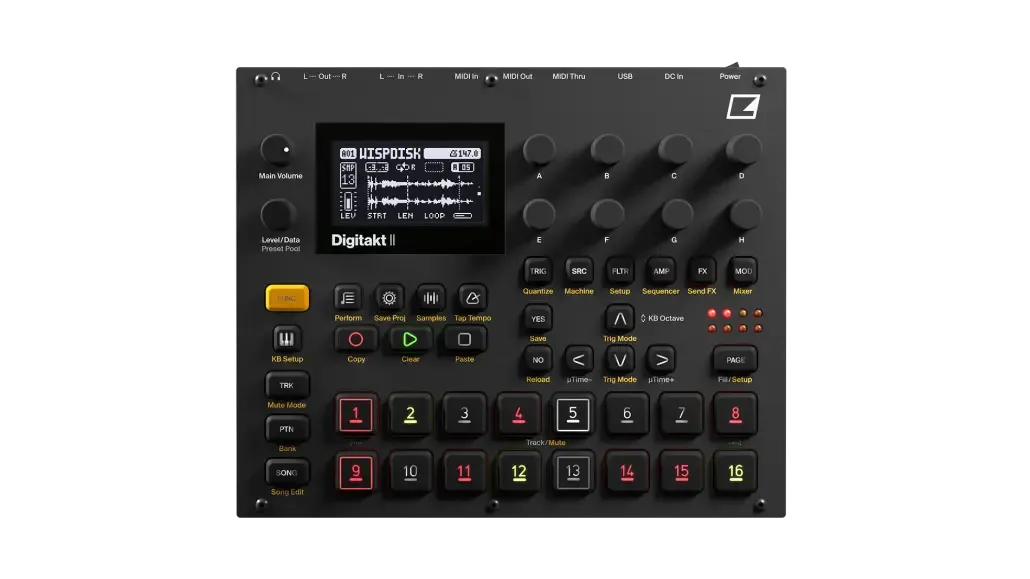
Elektron Digitakt II
Elektron Digitakt II is a groovebox that combines drum programming, sampling and a compact synth/sequencer workflow. It features 16 tracks that can handle stereo or mono samples, or MIDI data, with a robust memory architecture stated as 400 MB for samples and 20 GB of internal storage. The device offers five SRC (sample manipulation) machines and five FLTR (filter) machines per track, plus per-track filters, overdrive, a stereo master overdrive and compressor, and three assignable LFOs. Its sequencer provides 128 steps per pattern and per-track pattern length control, alongside parameter locks, micro timing, and an Euclidean sequence generator, enabling intricate beat and texture creation. The Digitakt II emphasizes modular sound design and live/studio versatility. Users can sample internally or externally, chunk samples with advanced tools like Slice and Grid, and apply effects such as delay, reverb, chorus, and bit/sample-rate reductions. Each track can have independent routing for audio or MIDI, with MIDI Learn and renamable CCs enhancing external gear control. The unit includes full Overbridge compatibility for DAW integration and connects via balanced ins/outs, USB 2.0, and standard MIDI I/O. Typical use cases include standalone beat production, sample-based groove creation, and live performance alongside external synths or drum machines. Its keyboard mode and 36-scale options support melodic work, while Song Mode lets users assemble patterns into longer sets. The Digtakt II is built in a sturdy steel chassis and weighs about 1.48 kg, designed for portable studio setups and on-the-fly sonic experimentation.
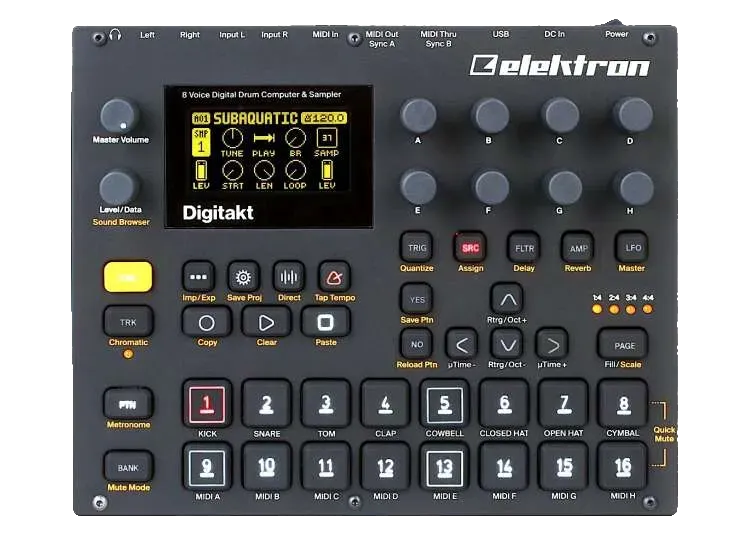
Elektron Digitakt
The Elektron Digitakt is a portable sampler and drum machine in the digitakt and elektron family. It features a compact chassis and multiple I/O options, including MIDI In/Out/Thru, USB 2.0, two 1/4" balanced outputs, two 1/4" inputs, a 1/4" stereo headphone jack, and a dedicated set of inputs and outputs for live routing and syncing. The device is designed to sample and sequence audio, with an emphasis on hands-on editing in a compact format suitable for portable use and live performance. Key capabilities include sampling from inputs and manipulating audio across eight audio tracks, complemented by eight dedicated MIDI tracks for sequenced control. This setup supports sample-based workflows, with a focus on sound design and performance-oriented tweaking via assignable LFOs and a multi-mode filter per audio track. Overbridge support facilitates integration with computer-based workflows, while the device’s internal +Drive storage and file management enable saving and recalling sounds and projects, preserving factory content and user files. Typical use cases for the Digitakt include nomadic beatmaking, live performance setups, and experimental sampling where hands-on control and quick access to parameter changes are valuable. Its workflow encourages creative manipulation of samples and patterns, with a design that supports spontaneous sound design and iterative pattern creation. The unit’s form factor and feature set make it a compact centerpiece for portable studios or performance rigs.
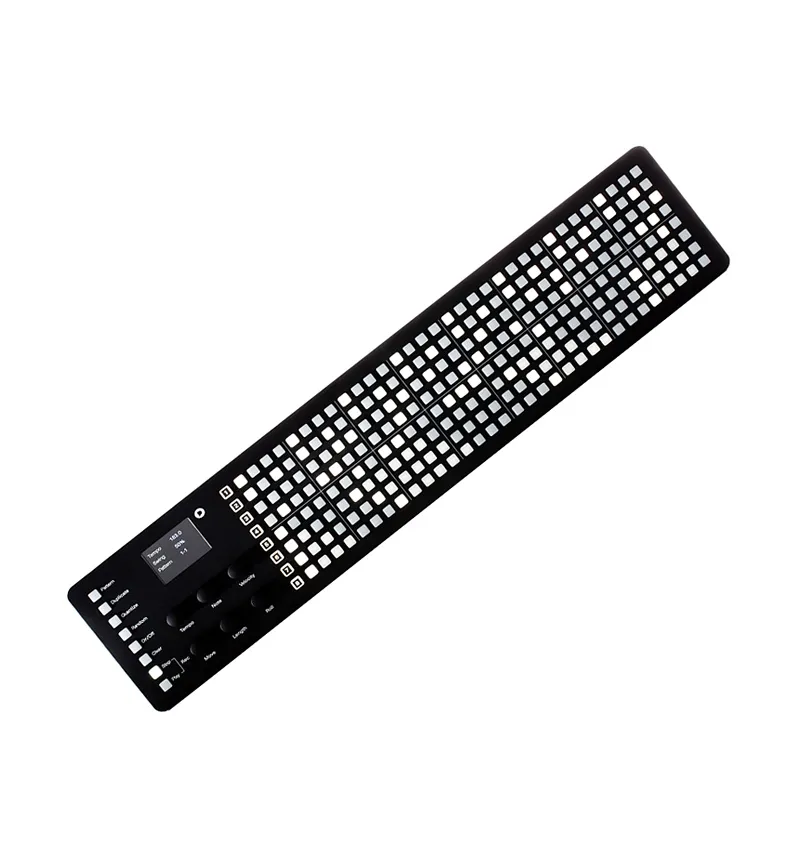
Polyend Seq
Polyend Seq is a standalone hardware sequencer designed for Eurorack and broader MIDI use. It functions as a polyphonic 8-track, 32-step MIDI sequencer with 256 pattern memory, and it offers live recording and on-the-fly track parameter randomization. Front-panel access provides quick control over step parameters such as Note, Velocity, Length, Modulation, and Roll, with independent track play modes (Normal, Reversed, Pingpong, Random). The device is equipped with a range of I/O options including MIDI input, MIDI Thru, two independent MIDI outputs, USB for bidirectional MIDI communication, and a footswitch input to control start, stop, and record, enabling flexible integration with other equipment. Its feature set supports both rhythm and melodic work, including the ability to record in real time from external MIDI controllers and to chain patterns for more complex arrangements. The Seq is designed to be used as the heart of a modular setup, capable of communicating with other devices and applications through its extensive I/O and USB connectivity, while maintaining a user-friendly workflow with most functions accessible from the front panel. Typical use cases include studio sequencing of multiple hardware devices and live performance setups where immediate, hands-on control and polyphonic sequencing are advantageous. The device emphasizes straightforward operation and broad compatibility, with pattern memory and automatic saving of parameter changes to streamline creative work.

Arturia MiniFreak
Arturia MiniFreak is a hybrid instrument, blending analog and digital technologies in a polyphonic synth. It offers six-voice polyphony with two digital oscillators and an analog filter, plus a 7x13 modulation matrix and a 64-step sequence. In front, four encoders provide hands-on control for design and performance, while a dedicated front panel keeps many functions quickly accessible. The unit ships with a substantial preset memory and a software-agnostic, intuitive workflow designed for versatile sound design. Key features include a wide range of oscillator modes (23), a polyphonic arpeggiator and a 64-step sequencer, and a multi-mode resonant filter. The modulation system supports multiple destinations and envelopes, enabling intricate timbral shifts and dynamic control. Onboard effects and the compact, tactile interface contribute to a broad sonic palette, from punchy leads to evolving pads. The hardware includes external 12 V, 1 A power and a trio of MIDI-DIN, USB-B, clock in/out, and reset out I/O, supporting integration with other gear and synchronization. Typical use cases include studio sound-design sessions and hands-on live performance where immediate access to sound-shaping tools matters. The sound character spans from tight, percussive digital tones to richer analog-filtered textures, with extensive preset memory for quick access and exploration. The software variant MiniFreak V mirrors the hardware’s architecture for seamless integration in a digital workflow.
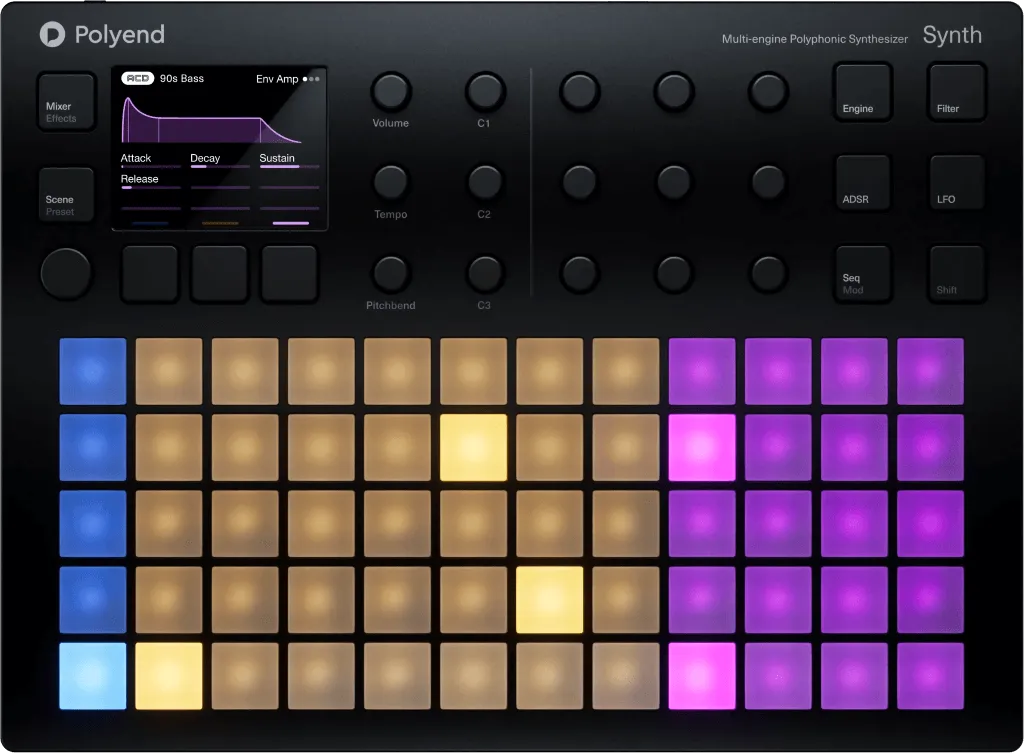
Polyend Synth
Polyend Synth is a compact polyphonic multi-engine synthesizer designed for modern production and live use. It belongs to the synth and digital workstation category, offering three engines playable simultaneously and a choice of nine engine types through a 3×3 knob matrix and smart grid workflow. Key features include independent three-synth playback with three effects and three sequencers/arpeggiators, plus a responsive visual interface and polyphonic aftertouch. The device supports USB-C power and USB connectivity, as well as MIDI In/Out/Thru, DIN MIDI, and stereo line/headphone outputs, making it a flexible tool for sound design, texture creation, and live performance. Storage is accessible via microSD, and the system emphasizes quick patch creation and scene recall with per-engine parameter control. Typical use cases involve creating evolving textures and layered sounds across three engines at once, using per-synth effects, and sequencing or arpeggiating parts for live or studio setups. The sound design leans toward experimental textures, granular and wavetable possibilities, and a broad sonic palette enabled by its multi-engine architecture.